
In an era where technological innovation drastically reduces costs and operational complexity, migrating Business Intelligence platforms is no longer the insurmountable barrier it once was.
Many companies are ready to switch their Business Intelligence platform, but the idea of manually rebuilding dashboards, reports, and data flows often stops this crucial decision. Migrating between BI systems has always been a complex, expensive, and high-risk operation.
However, today things are changing. With the support of Artificial Intelligence, a process long perceived as a project nightmare is becoming a smooth, automated, and surprisingly intelligent operation.
Beyond “Copy and Paste”: Why Traditional BI Migrations Are a Problem
Migrating a BI system is much more than simply moving tables, formulas, and visuals.
Migration is a precision job that requires:
- Complex Business Logic: converting custom calculations, KPIs, and metrics.
- Data Connections: redirecting all links to databases, APIs, and data warehouses.
- Design and Usability: redesigning dashboards and visualizations to fit the new platform.
- Data Consistency: preventing human errors and loss of integrity during the transfer.

Imagine a scenario where a BI site containing hundreds of reports and dashboards needs to be migrated from one platform to another manually. The result? Weeks or even months of work, growing budgets, and an “analytics blackout” period that is often unacceptable for the business.
An Intelligent Engine for Automated Migration
In this scenario, a migration engine powered by Artificial Intelligence acts like both an architect and a highly specialized technician.
This is how we are witnessing a clear shift in the rules of the game, starting from the most critical and decisive phase of a migration project, the Assessment.
The automatic Assessment phase is crucial to the entire process and is based on two fundamental concepts:
- Classification and Prioritization: metadata is classified according to predefined criteria (for example, sensitive data, critical processes, regulatory requirements) to support planning and prioritizing the safe migration of critical information.
- Complexity Evaluation: clustering based on the complexity of each report (business logic, formatting, data sources, filters) to determine the most suitable migration approach (for example, automatic conversion vs. manual refactoring).
With the initial “boosted” phase of Deep Assessment, the project becomes clear and feasible. In a short time, we can define objectives, timelines and costs, required resources, and a structured work plan.
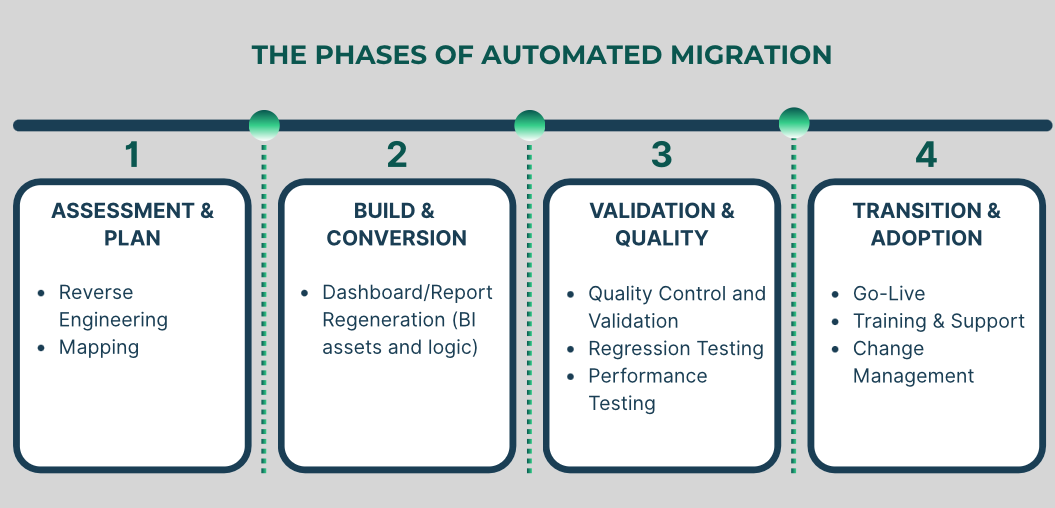
Reverse Engineering and Context Understanding
AI algorithms read and interpret the structure of the source BI platform. They do not simply copy the code behind a metric, they understand its semantics and business purpose.
This makes it possible to recreate the same logic in the destination platform, even if the syntax is completely different.
Automatic Object Mapping
During this phase, objects are automatically classified and mapped through a complete analysis of all metadata (tables, measures, dimensions, and their relationships).
The system identifies similar elements between the Source and Target platforms and suggests (or automatically applies) the most efficient mappings, learning from user choices to improve over time. This process is called GAP ANALYSIS.
Intelligent Dashboard Regeneration
This is perhaps the most surprising aspect. With AI, we do not simply recreate a chart, we optimize its design. By analyzing metadata, an intelligent engine can suggest more effective visualizations or adapt layouts to make the best use of the new platform’s features.
Continuous Quality Control and Validation
Throughout the migration, outputs from the new platform can be constantly compared with those from the original one, identifying (or correcting) any discrepancies. This guarantees that, once the migration is complete, your KPIs remain accurate and reliable.
Tangible Benefits: More Than Just Saving Time
Adopting an AI-driven automated migration solution does not only mean being faster, it means:
- Reduced project costs.
- Reduced risk, with almost total minimization of human errors.
- Business agility, enabling platform changes to leverage advanced features or more advantageous pricing models without being locked in by migration costs.
- Resource liberation, allowing analysts and developers to focus on innovation instead of translation work
- Governance and automated documentation, with centralized, versioned assets and up-to-date documentation of everything migrated, improving governance processes on the new target system
Adopting an intelligent engine does not eliminate the need for human supervision, but it automates repetitive and time-consuming activities, freeing IT teams to focus on more strategic and higher-value initiatives.
Conclusion: Migrating with CoCoBI
BI platform migration leaves behind a painful IT project thanks to a simple yet smart “engine swap.”
CoCoBI enables this transformation by providing not only automation, but also contextual intelligence and optimization.
The CoCoBI migration process rigorously follows every project phase with a high level of automation.
At each stage, AI shifts the focus from “manual execution” to “intelligent orchestration.”
Organizations adopting CoCoBI are not just solving a technical issue; they are preparing for a future where analytical agility becomes a decisive competitive advantage.
The result:
- Teams free to innovate.
- Reliable and consistent outcomes
- Continuous operational performance