
For years, Business Intelligence has been an exercise in memory: it collected what had already happened, organized it, and displayed it in a readable way. Today, that definition is already archaeology.
Modern BI no longer looks at the past: it intervenes in the present. It does not describe: it anticipates. It does not support: it directs.
This shift is not aesthetic, but structural. It occurred when AI entered the BI cycle not as an add-on, but as part of the decision-making mechanism. The moment the machine decides what to surface, which anomalies to promote, and which scenarios to propose, BI stops being information and becomes operational power.
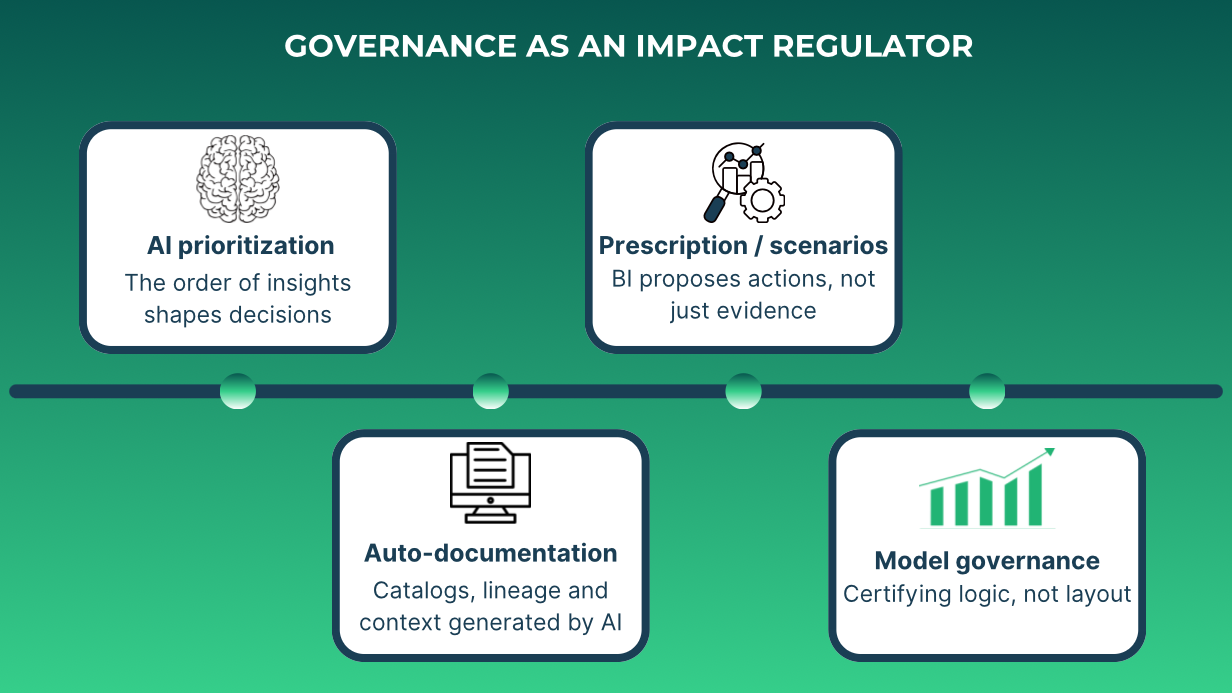
That’s why governance must evolve. Governing pre-AI BI meant managing standards, access, naming conventions, certified semantics. But when BI begins to influence action, governance can no longer limit itself to validating objects, it must govern consequences.
This is why CoCoBI was created: with the support of artificial intelligence, it represents the evolution engine of Business Intelligence.
Integrating intelligent technologies into governance processes means not only improving the efficiency and quality of information, but also enabling a new decision model that is more conscious, transparent, and predictive.
Companies that have already made this cognitive realignment are measuring tangible effects: decision latency reduced by 30–50%, fewer interpretative conflicts, less need for “human translators” between data and business, greater symmetry between insight and action.
This is not a productivity improvement, but a change of species: BI stops producing reports and starts producing decisions.
The BI that explains itself: governance of comprehensibility
One of the most underrated friction points in organizations is not the lack of data, but the lack of context. Where data is not explained, BI stops. CoCoBI, with AI, overturns this: it produces documentation as BI evolves.
Today, Ai-governed BI with CoCoBI can:
📑 Generate readable narrative lineage (not just technical metadata).
💡 Explain why an insight emerged now and not before.
🔍 Justify why an anomaly was promoted or ignored.
🗣️ Summarize the rationale behind a recommendation in business language.
🧾 Produce comprehensible audit trails, not just technical logs.
This is not an accessory: it is what enables BI to be adopted without mediation.
BI that explains itself is BI that gets used.
Governing BI today means governing impact, not output
Many organizations still focus on “certifying reports.” But certifying a report that does not change any decision is merely cosmetic governance.
AI-driven BI governance measures something different: the real thing.
- Real-time insight-to-decision conversion
- Gap between AI recommendation and final human choice
- Predictive drift and automatic correction
- Economic impact of insights deployed in production
- Operational risk of AI-mediated decisions
Decision Intelligence and algorithmic responsibility
The integration of AI into BI governance does not merely improve operations, it opens the door to a new paradigm: Decision Intelligence. This approach combines data analysis, predictive modeling, and scenario simulation to support decisions based on evidence, not intuition.
However, the use of AI also introduces new responsibilities: organizations must ensure model transparency, decision traceability, and the explainability of analyses and algorithms (Explainable AI). Only under these conditions it’s possible to maintain user trust and respect the ethical principles of responsible artificial intelligence.
This is not just Data Governance. It’s BI governance as a decision-making mechanism.
Benefits and challenges for organizations
Applying AI with CoCoBI to Business Intelligence governance brings tangible benefits: greater data accuracy, reduced operational costs, faster decision-making processes, and improved compliance control.
However, organizations must also address several challenges:
- Technological integration, to combine AI tools with legacy BI platforms.
- Data culture, to educate users and decision makers on the responsible use of artificial intelligence.
- Ethical governance, to ensure that algorithms reflect corporate values and principles of fairness
Only through a balanced approach that aligns technology, processes, and organizational culture will it be possible to create truly intelligent BI governance, capable of transforming data into sustainable strategic value.
Conclusion: it’s the speed of decisions that makes the difference
AI-powered BI is not “better BI,” it is BI with a different role.
It does not produce representations, but pre-configured actions.
It does not assist, it accelerates.
It does not support, it decides in advance.
This is why governance must shift: no longer from the object (the dashboard) but from the consequence (the decision).
In 2025, the advantage is not having well-polished BI, but reducing the distance between event, insight, and action. Organizations that treat BI as a living software (continuous coding), delegate part of selection, documentation, and prescription to AI, and govern impact instead of output, are already seeing measurable gains: less inertia, fewer interpretative conflicts, more good decisions made earlier than others.
Competition has moved: the winner is not the one who sees more, but the one who puts better decisions into production, faster.